There are many things in our lives we take for granted. We often do not know the origins of the things we use every day. One thing you might not have considered is why some garments have zippers on the left while others have them on the right. Let’s delve a little deeper and find the answers.
This year’s theme for the Met Gala was “The Gilded Age.” While many A-listers didn’t stick with the theme, the Gilded Age was a time of extravagant gowns and dresses next to impossible to put on by yourself.
Women during the Gilded Age needed a helping hand to put on a dress. It was easier for someone to button up the dresses on the right, considering most people are right-handed. Additionally, mothers often hold their children with their non-dominant arm to feed them. It’s much more convenient for right-handed women to feed their children when their clothing accommodates them.
This theme continued for women’s clothing over the years once the zipper became a norm as women’s garments usually have the zipper on the left. There’s truly no rhyme or reason why this continues. All it does is fuel the left-handed people who claim the world is against them.
While women were stuffing themselves into corsets, men were dueling in the streets or fighting in wars. Thus, they needed to have a firearm close to their person. Men usually had a holster or sheath on their left side. In the same notion that right-handed people are at the forefront of the fashion world, men needed to grab their pistol quickly, and it’s much easier to go across with your dominant hand.
It’s also possible that the country of origin determines where the zipper is. You can go into your closet and look at your jackets or dresses. European designers will typically fall in line with men’s zippers on the right and women’s on the left. You can thank the monarchy for that. In North America, it’s a bit of a mixed bag, so it may be interesting to inspect your clothing and see if you notice a trend.
The truth is that no one can definitively answer why some zippers are on the left and some are on the right. We only have theories, although they’re highly logical ones that seem to stand the test of time. If you have a zipper on the left or right that’s causing a nuisance, consider getting a FixnZip zipper repair kit. Compatible with any zipper, the FixnZip can solve your zipper needs, so get one today!
There are few things more embarrassing in life than someone catching you with your fly down. While it may look like a simple goof to them, the true fault may lie with a defective fly that has a mind of its own. If you’re in a state of panic about your fly constantly unzipping, use these three tricks to help keep your fly from unzipping.
The best trick for preventing your fly from unfastening is to use some preventative care for your articles of clothing. You can ensure this by fastening all zippers before putting them in the washing machine. Open zippers can take the brunt of the damage in the machine. Plus, they can damage other garments. The second piece of advice is to dry your loads on low heat. High heat can scorch zippers, especially plastic ones. If you must, remove your clothes with zippers from your dryer load before using this setting. You can dry them afterward with lower heat or air dry them.
It’s nice to repair things with items lying around the house. A rubber band or key ring are two such items that can resolve the problem. A bystander won’t even be able to tell you to have a ring keeping the fly up. You can attach the key ring or rubber band through the small loop on your slider. That way, you can attach either one of those materials to the button of your pants. You can use this setup to zip your pants up, connect the ring to the button, and close the flap.
There may be a damaged piece of the mechanism, and the slider is the most common component that breaks. Thus, one method to fix your fly is to change the broken slider. Follow the subsequent steps to complete the job:
Hopefully, these three tricks to help keep your fly from unzipping work like a charm for your favorite pair of pants. And we have the easiest, more effective zipper pull replacement available. Due to its robust nickel plating, our FixnZip is the durable replacement you desire. Look at our zipper slider sizing and get your zipper repair kit today!
If you’re trying to get out the door in a hurry, you might throw on a pair of pants quickly and zip up, only to realize that your hasty zipper skills broke the fly on your jeans. Use this simple guide to fixing zippers on jeans to solve your dilemma without buying a new pair.
Broken teeth on a jeans zipper prevent the fastener from working properly. It’s one of a variety of causes for zipper failure. Depending on where the broken teeth are, you might be able to continue zippering. If the damaged teeth are more than halfway down the fly, you can fix them by adding a new stop. Otherwise, a complete replacement is necessary. Here is how to add a bottom stop:
Another popular method involves putting the zipper back on its track. The beginning of this process is different from the bottom stop, but you repeat the same steps once you finish the first step.
The first step you must do for this is to take the top stops off both sides. Once again, grab your trusty pliers and remove the top stops. It’s important to move the slider to the bottom of the zipper before you begin.
Regardless of what you try from our simple guide to fixing the zipper on jeans, Fixnzip is here to help you keep your fly fastened. Order a repair kit or replacement sliders to fix any zipper giving you issues in just a few clicks. Try additional methods like using wax to coat the teeth or adding a safety pin to prevent the fly from sliding down. Those are just a couple of ways to extend the life of a zipper.
Visit our store to order your repair kit today. Contact us with any questions!
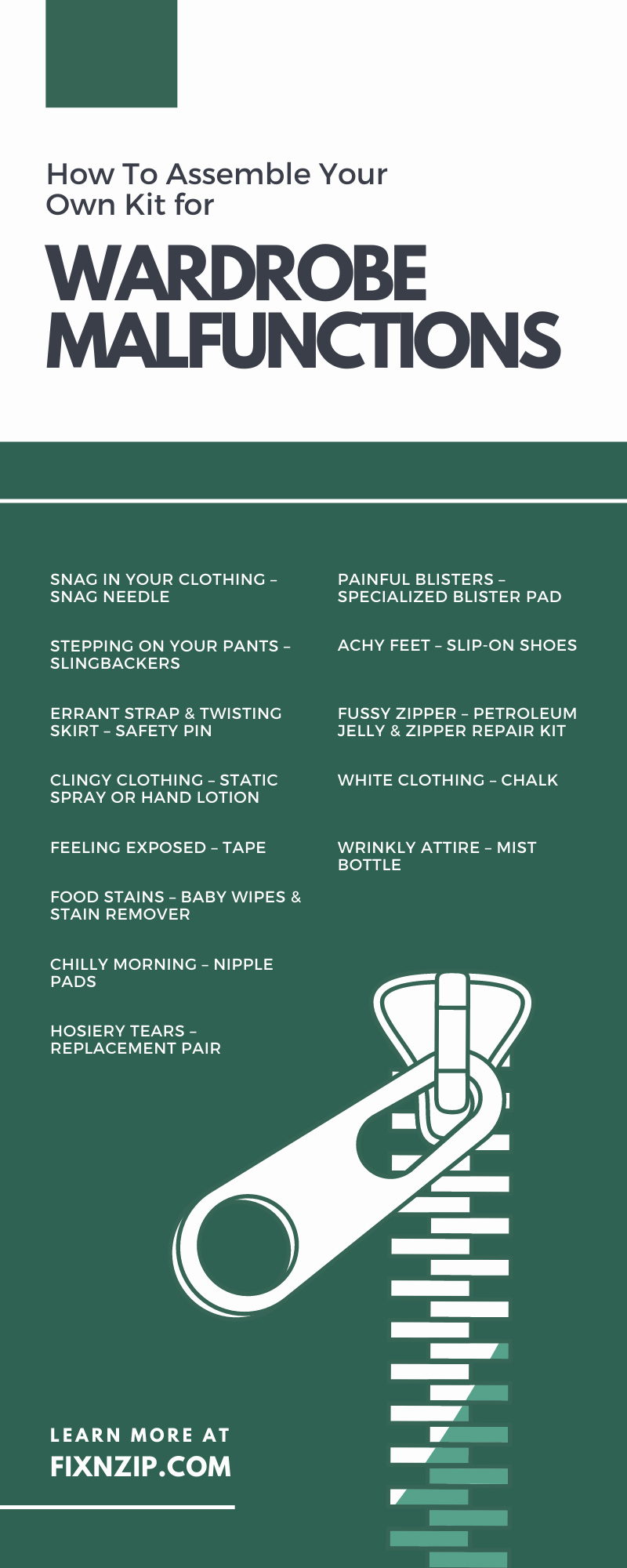
Ideally, we would all go through life without experiencing a minor inconvenience. However, that dream usually shatters within the first five minutes of your day. One of the most common issues people have is an untimely wardrobe malfunction. But knowing how to assemble your own kit for wardrobe malfunctions can limit those embarrassing mishaps. Here’s an overview of what could go wrong and the tools you need to fix these problems.
Some quick needlework can repair your article of clothing. A loose thread on a sweater, pair of slacks, or jacket can be a harbinger of a larger problem ahead. All it takes is one errant move to cause a loose thread, and that thread can ruin the garment. You should include a snag needle in your kit to avoid this ordeal.
You feel fierce when you look in the mirror wearing a stylish pantsuit with strapped footwear. However, you may not realize that the hem of your pants will slide underneath your foot as you walk until it’s too late. Instead of pulling it out all day long, you can purchase Slingbackers to close that gap, ensuring that your pants flow down the back of your leg correctly.
Wearing additional layers may lead to a loose strap having a mind of its own. While it shouldn’t be a big deal, it may distract others, especially if you give a presentation or have an intimate face-to-face conversation. Luckily, this fix doesn’t require you to have any special skills. It would be best to have a safety pin to keep your straps inside of whatever you’re wearing.
Another incident you’ll need a safety pin for is when a skirt twists as you walk. A scrunched skirt can happen from an ill-fitting waistband or carrying a handbag. Adding a pair of medium-sized pins to your waistband prevents that skirt from twisting.
We all know what static electricity can do with clothes, especially when you’re folding laundry out of the dryer. Other than the random shocks, it can be annoying that your clothing sticks to you like you’re a magnet.
Clingy clothes are extremely bothersome when you wear them, making static spray essential for any kit. Although, if you don’t have spray handy, you can use hand cream and rub it on the parts of your body most affected by the clinginess.
As Janet Jackson and many celebrities have shown, sometimes, it’s not easy to tuck things away. Certain outfits leave you more vulnerable than normal, so throwing some tape in your kit can prevent you from spilling out if you are flirting with disaster. If you want additional coverage, you can pack a neutral-colored camisole.
Most extravagant parties have dinner or hors d’oeuvres to eat as you speak with other guests. Every bite increases your chances of spilling some food on your clothes, leaving an embarrassing stain. Even if you are extremely careful, it’s bound to happen eventually. Thus, always include baby wipes and stain remover in your kit. Baby wipes can help you in various ways, so you should have them for tasks beyond removing blemishes. The stain remover is a pricier option, but it erases any spills within the blink of an eye.
A drastic temperature change may cause a certain part of your body to peek through your clothing. To avoid being the center of unwanted attention, it’s worth having some nipple shields in your kit if you fall victim to a stiff breeze, especially when lacking the layers.
Wearing hosiery leaves you susceptible to tears and rips when you least expect it, particularly when working in tight quarters under a desk. A swift turn or swivel could graze the edge of something, shredding your tights. Having a backup pair is essential if you wear hosiery because you don’t want to go all day with a giant hole showing.
While this isn’t necessarily a malfunction, it’s worth having some blister support in your kit. Constantly being on your feet for your job may develop some blisters on the most sensitive parts of your foot. Everyone knows how painful that irritation can be, mainly when it rubs against your shoe. To prevent it from popping and wreaking more havoc, go into your kit and pull some blister pads to alleviate the pain.
The odds are most people that wear heels have taken them off at one point in the night. You’ve certainly seen someone walking home with their heels in their hands. Rather than walking home barefoot or in shoes that give you unbearable pain, opt for a pair of foldable slip-ons. You don’t need to break the bank for a pair of these, and most retail stores have pairs for less than 20 bucks.
There are few things as frustrating as a faulty zipper. Whether it’s immovable or off to one side of the track, it’s a helpless feeling when it happens. Adding some petroleum jelly to your kit will help lubricate the most stubborn zipper sliders. You can also include a zipper repair kit for a sure-fire solution.
Wearing white is always a risky decision. Even a dribble from a clear liquid can leave a noticeable impression on your clothing. Additionally, it can be next to impossible to rub out a stain on white attire. A quick and cheap hack is adding chalk to your kit. It’s not a long-term solution, but it helps you in a pinch to chalk out the spillage.
When you’re in a rush, you may have no other option than to grab a wrinkled shirt or pants. And wrinkled clothes give the appearance of someone who is unkempt. Once you get to your destination, take a quick detour to the restroom, grab the mist bottle from your emergency kit, and let it air dry. It’s not as effective as a steamer, but it works well when you’re under pressure.
That concludes the tutorial on how to assemble your own kit for wardrobe malfunctions. As you can see, many bad things can happen on any given day, specifically regarding what you’re wearing. Fortunately, FixnZip can help with some malfunctions with our zipper repair kits. Using one of our kits in a dire situation will assist you in getting that zipper working again!
The goal of everyone’s day is not to do anything embarrassing. Some incidents happen when you least expect them, like when the zipper on your pants has a mind of its own. However, it may be more challenging being the one relaying that message to someone else. Learning the best seven ways to tell someone their zipper is down can help downplay a tricky situation.
We’ve all been in an embarrassing predicament like having your fly down on your pants. The best way to handle the situation is to go back to the timeless adage, “Treat people how you want them to treat you.” Please do not be rude when you tell them of their unfortunate mishap. Be as courteous as possible, especially when something is sensitive like this.
Don’t bring additional attention to the situation by looking down at them and saying their zipper is down. If you do that, the individual will accuse you of gawking, escalating a tense situation. Instead, look at them directly in their eyes and kindly tell them that their fly is down. Hopefully, they don’t take any offense to it, zip it up, and go on their way.
You wouldn’t want someone to scream something embarrassing about you for everyone to hear. Therefore, pull them aside and tell them quietly. In fact, you don’t even have to say anything at all, considering you can do it with a nonverbal cue.
Now that you know what to do when someone has their fly down, let’s educate you on the best seven ways to tell someone their zipper is down.
Of course, there are additional ways to add some comedy to the situation. But unless you know the person well, it’s best to play it safe and keep it casual. You never know when someone will take a joke the wrong way.
If your fly is down because of a broken fastener, check out FixnZip! Rather than tossing your favorite pair of pants in the garbage, you can use a zipper repair kit to get them looking brand new.
You’ve been using zippers your entire life, but when it comes to understanding how zippers work, you likely only care when one breaks. Few people know the fascinating history of the zipper, let alone the mechanics of how they work. Keep reading to learn more about this timeless piece of engineering.
To understand how zippers work, you should know the pieces that comprise a zipper. While not all zippers are the same, they typically have some common components. Elements of a zipper include:
The basic mechanics of a zipper revolve around the interlocking teeth. Zippers have two strips consisting of many teeth that are designed like a hook and hollow and must interlock at a specific angle. The zipper slide is a latching mechanism that is engineered to connect and separate the teeth. The strips of teeth are slightly offset from each other, allowing them to interlock. With a well-made zipper, only the slide will be able to undo the teeth.
Zippers come in all sorts of shapes and sizes. Heavy-duty zippers tend to be larger, while thin zippers are vulnerable to breakage. Typical zipper materials include molded plastic, metal, and nylon coil, but you have many other options when it comes to zippers too. The type of zipper you are using will depend on the item it is attached to. For instance, stops are needed for backpacks but wouldn’t be helpful on a jacket. Common zipper styles include:
Learn about even more types of zippers here.
You can use your knowledge of understanding how zippers work to level up your clothes-making endeavors or better repair the next broken zipper on your jacket, purse, or tent. Zippers can bust when the teeth or slider become damaged. A quick and easy fix is to attach a FixNZip® zipper replacement. This easy replacement zipper fits on any size zipper and is easy to install. Shop our online store to get yours today.
Did you recently pull out your raincoat from last year only to discover that the zipper is busted? Or maybe your grandma gave you her leather coat from when she was your age, and though it’s back in style, the main zipper doesn’t work anymore. Don’t let these items gather dust in the back of your closet. Learn how to replace the zipper on your favorite jacket so you can extend the life of your most valuable clothing items.
Sometimes, a zipper seems broken when it is merely in need of a simple repair. Some people recommend a pair of pliers to pinch the tabs back onto the track. This is typically if your zipper is separating. Read here to find out if your zipper can be repaired. If you choose this route, use your pliers to pinch down on both sides of the pull until the tab runs smoothly on the track without separating. Please be aware aware, this is a temporary solution, since squeezing the slider with pliers can cause it to further wear out. Also, using pliers runs the risk of damaging the slider, or worse, ruining the zipper teeth.
If you have a broken zipper on an older coat, the pull might be stuck due to missing or broken zipper teeth or something caught in it. You used to need zipper repair parts, which involved finding the right size zipper pull tab replacement and sewing in a whole new zipper. The project required pliers, needle, and thread, and it took so much time to do that many people chose to buy new clothes rather than go through the hassle.
But don't worry, you can keep wearing your precious heirlooms and practice sustainable fashion by using a no-sew zipper replacement piece. A FixnZip zipper slider replacement fits on any size zipper, and it much cheaper than having it professionally repaired.. To use it, loosen the thumbscrew and fit the slider over one side of the track. Tighten the thumbscrew, then loosen it about a quarter of a turn so it can easily slide on the track. Next, you can insert the other side of the zipper track into the FixnZip and use your jacket. Adjust the thumbscrew as needed if the track separates. You can also check out the video below for instruction son how to repair a jacket zipper with the FixnZip. The video can be applied to zippers that are missing the zipper slider as well.
Never throw away another jacket due to a broken zipper again. You can use the FixNZip on more than jackets; it is ideal for anything that requires a zipper. Now that you know how to replace the zipper on your favorite jacket with a FixnZip, you can fix a zipper on anything from a backpack to a tent.
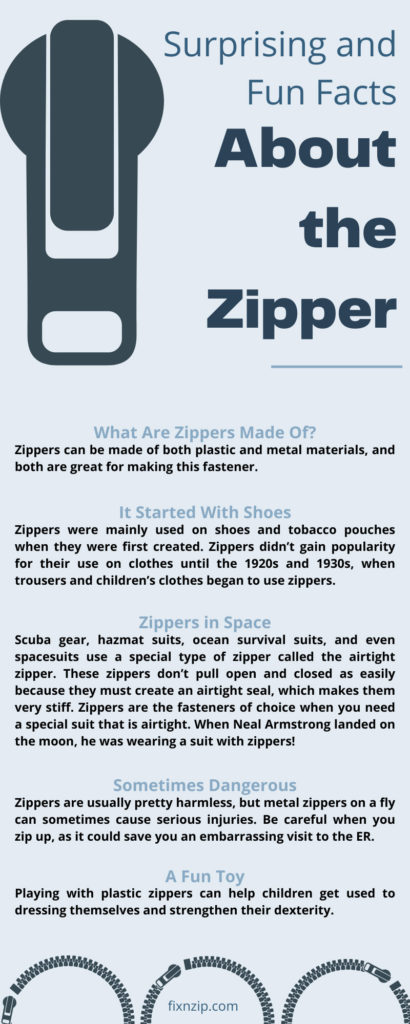
You may take the zipper on your clothes for granted, but it has a rich history of how it came to be. Learn these surprising and fun facts about the zipper and improve your trivia game.
Zippers are comprised of four elements. The “stringer” or “tape” is the cloth at either side of the zipper. The teeth are the small interlocking parts of the zipper. The zipper slider is the part which opens and closes the teeth as it slides over them. The zipper tab is the part of the zipper you use to pull the slider. Most zippers also contain a top and a bottom stop at either ends of the teeth. Zippers can be made of both plastic and metal materials, and both are great for making this fastener.
Zippers are a very versatile fastener. They’re not just on your jeans! A few uses for zippers include clothing, shoes, luggage, camping supplies, and much more.
Zippers are no joke in the business community. In the US, people utilize 4.5 billion zippers every year. That’s a lot of zippers per person!
People give credit to a few inventors for creating the zipper, but only one invention really resembles the zipper we use today. Elias Howe is sometimes credited with creating the zipper, but his invention more resembles an elaborate drawstring. Whitcomb Judson is also commonly cited as the inventor of the zipper, but his device, the clasp locker, is more of an elaborate hook-and-eye fastener. The true inventor of the zipper we know today is Gideon Sundback. Sundback’s device included teeth and a zipper slider that pulled them to a close, so he is the true inventor of what we know as a zipper. Without Gideon Sundback’s patents in 1913 and 1917, we would still be buttoning our flies closed.
The first few attempts at making zippers were all while trying to create fasteners for shoes. We don’t often think of shoes first when it comes to zippers, but they have a valuable place on your feet as well as your jeans. Zippers were mainly used on shoes and tobacco pouches when they were first created. Zippers didn’t gain popularity for their use on clothes until the 1920s and 1930s, when trousers and children’s clothes began to use zippers.
Before zippers got their name, “separable fasteners” was the name for zippers. In 1923 the B.F. Goodrich company put zippers on their goulashes and called the closure the zipper. This name, that mirrored the sound zippers make, stuck, and zippers became something we know and love.
The US Military was one of the first big customers buying zippers. They used zippers on US Navy gear in World War I, which lead to the popularization of zippers. The Navy purchased the zippers for use on windproof flying suits!
You’re going to revel in astonishment at this surprising and fun fact about zippers. Scuba gear, hazmat suits, ocean survival suits, and even spacesuits use a special type of zipper called the airtight zipper. These zippers don’t pull open and closed as easily because they must create an airtight seal, which makes them very stiff. Zippers are the fasteners of choice when you need a special suit that is airtight. When Neal Armstrong landed on the moon, he was wearing a suit with zippers!
The Rolling Stone album, Sticky Fingers, featured a photograph of jeans taken by Andy Warhol. The jeans had a working zipper and revealed underwear beneath them, also Andy’s idea. Zippers have earned their place in rock and roll and art history!
In 1954, Levi’s first used the zipper on a pair of overalls, the 501Z. It wouldn’t be until the 1970s that they would begin to use zippers on more of their jeans. Before that, the button-fly reigned supreme.
If you notice a YKK on your zipper, that stands for the Yoshida Kogyo Kabushikikaisha company. The YKK company makes more than 1.5 billion zippers a year and operates in 71 countries with 39,000 employees. Beware, though, as YKK zippers can be counterfeit.
In Outkast’s song “So Fresh and So Clean” YKK gets a shoutout from the group. This is even more evidence that zippers are important in pop culture, and not just clothes!
In the Oscar-winning film Amadeus, set in the 18th century, many of the costumes feature zippers, which wouldn’t have existed at the time. When you’re making costumes for historical films, it’s important to get all the details right.
Zippers are usually pretty harmless, but metal zippers on a fly can sometimes cause serious injuries. Be careful when you zip up, as it could save you an embarrassing visit to the ER.
Most of the world’s zippers are actually made in one place. The Qiaotou region of China produces more zippers than anywhere else in the world.
While your first thought of a zipper may be the one on your jeans, zippers can be concealed, too. Zippers are sometimes hidden under fabric, which is popular for clothing like dresses and skirts.
There are some zippers that lock into place. On a locking slider, the pull tab will only move when it’s lifted. If the pull tab is shut down, the zipper locks and can’t move. Be careful if you check to see if your zipper locks, though, as you could have one that doesn’t and wind up with a broken zipper!
Zippers aren’t only for clothes; they can also become fun activities for kids. Playing with plastic zippers can help children get used to dressing themselves and strengthen their dexterity.
Zippers break every day on clothes, but with Fix N Zip, you can replace broken parts of your zipper. Get replacement zipper sliders from Fix N Zip any time your zipper breaks.
When you’re designing your own clothes, choosing the right zipper might confuse you. Understanding the small differences of zippers that any sewer should know will aid your efforts in making the best attire possible.
The zipper that sewers use most often is an all-purpose zipper. It has small teeth and is generally light, with an end featuring a lock that keeps the zipper tape from falling apart. Most articles of clothing use this style of zipper as a closure. For a seam to bend or move with the line of a garment, you’ll need a heavy-duty fastener.
Sewers usually employ invisible zippers for formal wear, as they don’t obstruct the flow of a garment. An invisible zipper has fine teeth that one must sew into the item, hiding it in the seam. The only visible portion is the pull tab, which is usually smaller or less intrusive than those of other zippers.
Invisible zippers aren’t as long as all-purpose zippers, nor are they as colorful. However, any color will do because you can hide them in the seam. Lastly, using special sewing machine feet to stitch an invisible zipper is best, as the feet keep the coil still to hide the stitching.
Separating zippers—you guessed it—separate at the bottom. The type of dividing zipper you may need depends on its length and weight. Metal zippers are heavier than polyester or plastic tooth zippers, and they could weight down something light such as a fleece jacket. In contrast, a heavyweight wool coat would benefit from a metal zipper’s strength and stiffness.
Jean zippers feature brass teeth and a limited slider for a smooth cover flap. This zipper is sturdy and durable, matching jeans’ longevity. Unlike nylon coil and plastic-molded zippers, the strong brass jeans zipper has a nose that closes the asymmetrical seam, so the slider must face the right way.
Some clothing items have unique zippers that only work on that particular item. For example, sleeping bags have extra-long separating zippers that may reach 100 inches long. On the other hand, some materials have small zippers that are only 4 inches long—you’ll likely find those on children’s dolls. Finding these specialty zippers in a retail store is nearly impossible, so you might have to go to a fabric store or look online.
Knowing the small differences of zippers that any sewer should know helps any seamster in their endeavors of selecting the appropriate fasteners. If you need the most effective zipper pull replacement for your project, FixnZip has a vast selection of options available that will suit your needs!
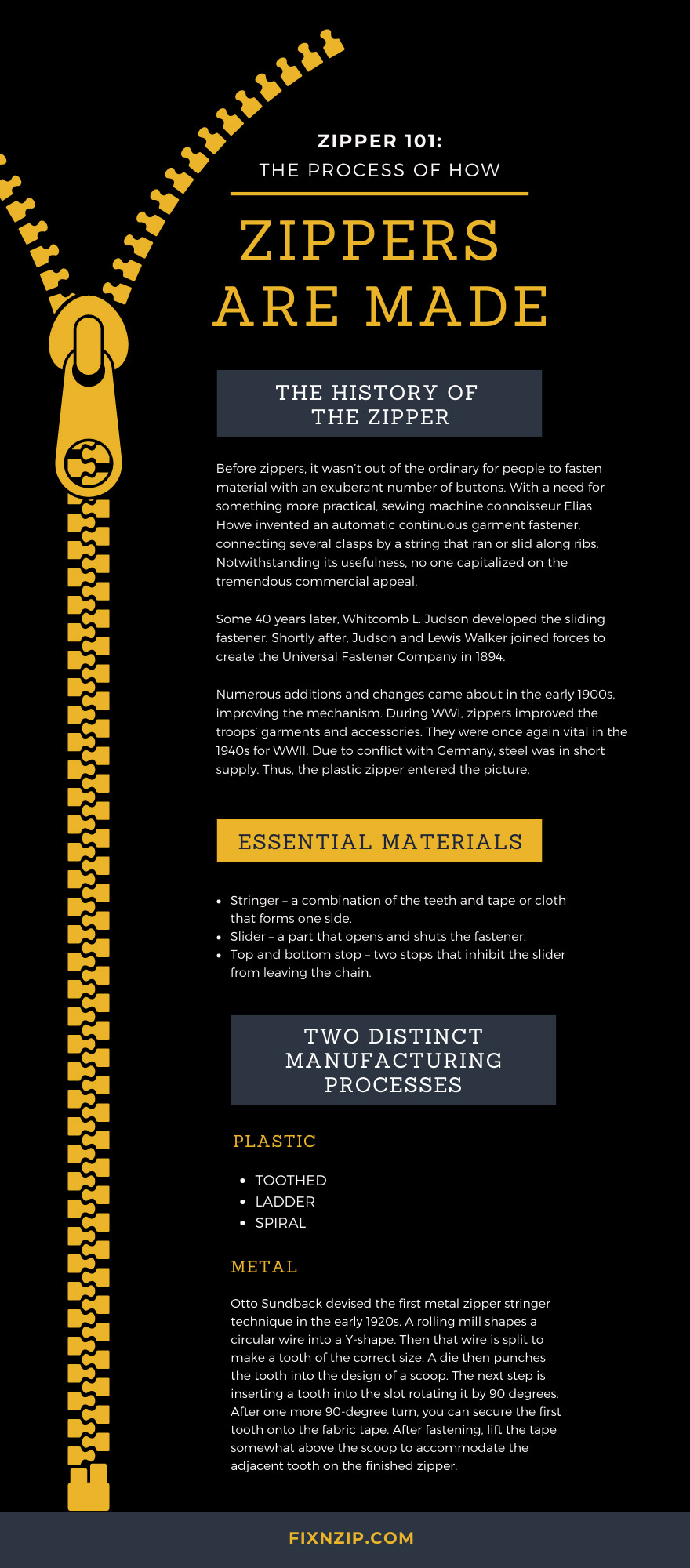
It’s easy to take zippers for granted. They have been around our entire lives, secure our money, tighten our boots, protect our luggage, and prevent wardrobe malfunctions. Albeit it is tiny in stature, it takes a rigorous process to make a zipper. Let this be your education on the process of how zippers are made.
Before zippers, it wasn’t out of the ordinary for people to fasten material with an exuberant number of buttons. With a need for something more practical, sewing machine connoisseur Elias Howe invented an automatic continuous garment fastener, connecting several clasps by a string that ran or slid along ribs. Notwithstanding its usefulness, no one capitalized on the tremendous commercial appeal.
Some 40 years later, Whitcomb L. Judson developed the sliding fastener. Shortly after, Judson and Lewis Walker joined forces to create the Universal Fastener Company in 1894.
Numerous additions and changes came about in the early 1900s, improving the mechanism. During WWI, zippers improved the troops’ garments and accessories. They were once again vital in the 1940s for WWII. Due to conflict with Germany, steel was in short supply. Thus, the plastic zipper entered the picture.
There are four fundamental components of a zipper:
Several materials create metal zippers—aluminum, stainless steel, zinc, and brass, to name a few. Most steel zippers use zinc or brass for coating, or they might match the color of the clothing. On the other hand, zippers consisting of plastic materials contain nylon or polyester, with the slider being steel. Lastly, the fabric tapes are either polyester, cotton, or a mixture of both.
Plastic and metal zippers each have a distinct manufacturing process. Read on to learn a bit more about both.
There are three types of plastic zippers: toothed, ladder, and spiral.
To manufacture the toothed option, you will employ a molding procedure like metal zippers. Then, a revolving wheel features microscopic molds formed like squashed teeth. In the end, two cables link the final teeth. When you pour semi-molten plastic into the mold, it will harden. Finally, a folding machine twists the teeth into a U-shape for sewing.
You can manufacture a ladder zipper by wrapping a plastic wire between two spools protruding from the edge of a spinning shaping wheel. On either end, strippers remove the loops off the spools, while a heading and notching wheel continuously pushes the loops into the shape of a “U,” forming heads on the teeth.
There are two ways to string a spiral plastic zipper. A notch in a plastic wire feeds two hot fasteners. These fasteners wrap the plastic thread in opposite directions. A head maker molds each loop into a round knob, using air to cool down the spiral. This approach employs two separate machines to create spirals on both sides of the zipper.
The second method makes two spirals solely on a single machine. A forming wheel spins a wire loop between notches. You make these notches by a pusher and a head maker, producing two linked chains ready to sew on two fabric tapes.
Otto Sundback devised the first metal zipper stringer technique in the early 1920s. A rolling mill shapes a circular wire into a Y-shape. Then that wire is split to make a tooth of the correct size. A die then punches the tooth into the design of a scoop. The next step is inserting a tooth into the slot rotating it by 90 degrees. After one more 90-degree turn, you can secure the first tooth onto the fabric tape. After fastening, lift the tape somewhat above the scoop to accommodate the adjacent tooth on the finished zipper.
Its appeal diminished due to it being a meticulous technique. A comparable approach followed to punch a flattened wire strip between a heading and pocket punch to make scoops. A blanking punch shapes the scoops into a “Y.” Next, clamp the Y legs around the fabric tape. This methodology left Sundback’s version in the dust.
After creating the individual stringers, connect them temporarily to a slider-like tool. After the pressing, you can clean the edges of the metal zippers, drying them out after the scrubbing. To ensure a smooth-functioning device, wax and wrap them onto large spools.
Stamp the pull tab and slider individually. For one-way zippers, clasp the bottom stop, then connect the slider onto the chain. Fasten the top stops on and trim the spaces within the teeth. You can coat the midway point of each gap with reinforcing tape, clamping the top stops. Now, dice the tape and divide the strips of the chain again. On one side will be the slider and box, while the opposite side will have the pin.
At this point, the assembly of a zipper is complete. Thus, they are ready to accompany the most delicate garments and accessories from around the world.
Zippers are intricate gadgets that operate on a seamless, nearly flawless connection of minuscule teeth. Because you use them to secure garments, they must pass the same testing as other clothing items.
Zipper makers strive for consistent performance. An inspection of each aspect of the fastener ensures its adequacy. The zipper’s measurements must be within 90 percent of the intended length; however, it is usually near 99 percent.
The extensive process to guarantee the quality of the zipper includes testing its strength, user-friendliness, durability, color, and fabric tape. The strength matters, as you shouldn’t be able to easily manipulate or break the teeth.
That said, you shouldn’t need 10 people’s strength to slide the device up and down. But it is nice that it’s durable enough to survive several hundred trips in the washing machine. Finally, confirm that the color and tape are the correct ones.
This concludes your course on Zipper 101: The process on how zippers are made. Hopefully, you have a better appreciation of the extensive process it takes to make something the size of a fingernail. If one of your zipper slidersis a defective one that slipped through the cracks, you can find several items at FixnZip that can help. We promise that any of our zipper replacement kits will make Elias Howe proud.