
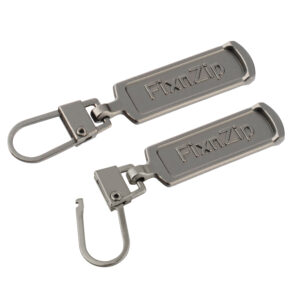
Have you ever struggled to open your tent, sleeping bag, or backpack because your zipper only has one pull? Whether you’re inside your tent trying to zip it shut or fumbling with your sleeping bag in the dark, adding a second zipper pull can make life a lot easier.
The FixnZip Replacement Zipper Pull allows you to add a second pull to your FixnZip Replacement Zipper Slider, giving you smooth and easy access from both sides—without any tools or sewing!
If your zipper is used frequently or needs to be opened from both sides, a second pull is a game-changer. Here’s why:
✅ Easy Tent Entry & Exit: Zip up your tent from inside or outside effortlessly.
✅ Convenient Sleeping Bag Access: No more struggling to reach your zipper in the middle of the night.
✅ Better Backpack & Jacket Functionality: Access your gear without twisting or adjusting awkwardly.
Our FixnZip Replacement Zipper Pulls are made from durable materials and come in four stylish colors: Black, Nickel, Graphite, and Dark Nickel.
Whether you’re an avid camper, hiker, or backpacker, this simple zipper pull repair trick will improve your outdoor experience.
Order yours today at FixnZip.com or find it on Amazon!
A broken zipper pull can make jackets, backpacks, tents, and luggage frustrating to use. Instead of replacing the entire zipper or struggling with makeshift fixes, the FixnZip Replacement Zipper Pull provides an easy, no-sew solution for zipper pull repair.
With no tools required, you can replace a missing or damaged zipper pull in seconds—restoring your zipper to full functionality without the hassle of sewing or repairs.
🔹 No tools or sewing needed – Simply clip it on!
🔹 Works on all types of zippers – Jackets, backpacks, tents, luggage, and more.
🔹 Durable & stylish – Available in Black, Nickel, Graphite, and Dark Nickel.
🔹 Saves time & money – No need to replace the entire zipper.
Whether you’re dealing with a broken jacket zipper, a worn-out backpack zipper, or a missing tent zipper pull, the FixnZip Replacement Zipper Pull is the fastest and easiest way to fix your zipper without replacing the entire thing.
Get yours now at FixnZip.com or find it on Amazon!
Introducing FixATent: The Ultimate Tent Repair Kit for Every Camper
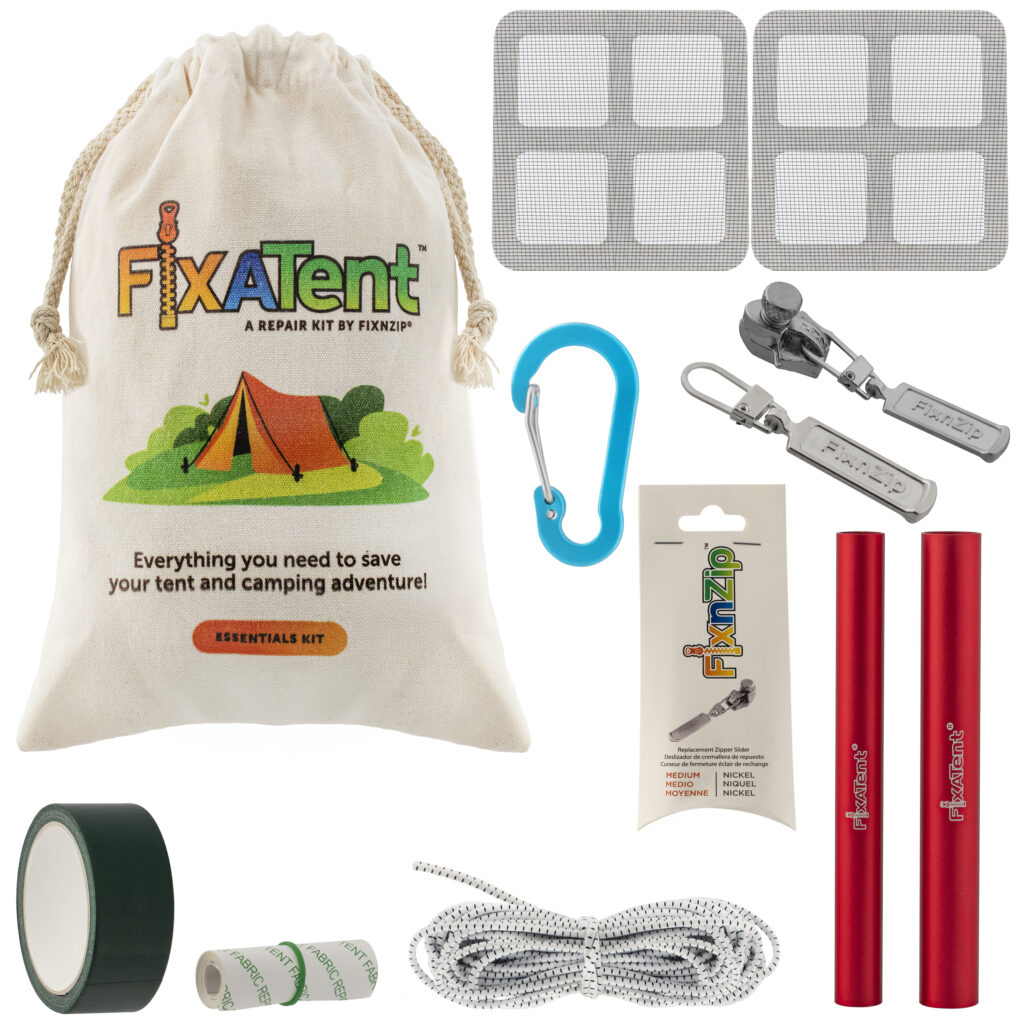
When you’re out in the wild, the last thing you want is a broken tent standing between you and a great adventure. A busted tent zipper, a torn tent mesh, or a snapped tent pole can turn an amazing camping trip into a frustrating experience. But don’t worry—we’ve got you covered! Meet the FixATent Tent Repair Kit, the all-in-one tent repair solution that keeps your tent in top shape, no matter what nature throws your way.
Imagine setting up camp under a sky full of stars, only to realize your tent zipper slider won’t close properly, or worse, your tent poles are bent. With the FixATent Tent Repair Kit, you can tackle these issues on the spot, ensuring your trip remains stress-free. This compact and lightweight kit includes everything you need to repair your tent in minutes, saving you time, hassle, and money.
Buying all these tent repair essentials separately could cost you over $50, but FixATent gives you the full package for just $29.99. Now, you can be prepared without breaking the bank!
Each tent repair kit includes high-quality, durable tools to handle a variety of tent repairs, including:
✔ FixnZip Medium Nickel Replacement Zipper Slider – A universal tent zipper repair solution that quickly fixes broken tent door zippers and keeps bugs and the cold air out. ✔ FixnZip Nickel Replacement Zipper Pull Tab – Replace or reattach a missing tent zipper pull tab for a smooth and secure zipper function. ✔ Tent Pole Splints (1/2" & 5/8") – Quickly repair snapped or cracked tent poles with these durable tent pole repair sleeves, designed for both small and large camping tents. ✔ 10' Roll of Duct Tape – A must-have for emergency tent repairs, from reinforcing tent poles to patching up unexpected tent fabric tears. ✔ 25' Shock Cord (Elastic/Bungee Cord) – Essential for replacing broken tent shock cords, tent guy lines, or other elastic tent repair needs. ✔ 2 Self-Adhesive Screen Patches (4" x 4") – Fix rips or holes in your tent mesh screen with ease, keeping insects out while maintaining ventilation. ✔ 2" Carabiner – Perfect for hanging your tent repair kit, securing loose camping gear, or keeping important items clipped and accessible during your trip.
✅ All-in-One Tent Repair Solution: Say goodbye to searching for individual tent repair items—this kit has everything you need in one place. ✅ Lightweight & Portable: Designed for campers, hikers, and backpackers, it won’t weigh down your pack. ✅ Cost-Effective Tent Repair Kit: Get more for your money with a camping repair kit that saves you over 50% compared to buying each item separately. ✅ Reliable & Durable: Made from high-quality camping gear materials, each tool in the kit is built to last—even in tough outdoor conditions.
A damaged tent can put a damper on your adventure, but with FixATent, you’ll always have a tent repair kit at your fingertips. Whether you’re camping, hiking, or exploring the great outdoors, this kit ensures that small tent repairs won’t ruin your experience.
Don’t let an unexpected tent repair emergency cut your trip short—get the FixATent Tent Repair Kit today and camp with confidence!
👉 Buy now at FixnZip and Amazon!
Do you ever put on your favorite skirt or jacket and find an abnormal curvature in the zipper that sticks out? This oddly shaped extension is, at best, unsightly and, at worst, physically uncomfortable. There are a few different names for this phenomenon, but typically, it’s called puckering. Today, we’re going to look at what zipper puckering is and how you can fix it.
Zipper puckering, sometimes known as bulging, is when your zipper curves or bends on a garment or bag in a way that causes it to stick out in a small bump or wrinkle. This bulge looks sloppy, improper, and peculiar on many pieces of clothing. In some situations, the areas where your zipper puckers may pinch or cling to your body in a physically uncomfortable manner. Either way, it’s not something you typically want to have on your clothes.
Many things can result in zipper puckering, and some are easier to avoid than others. One of the most common causes you often see on zip-up sweatshirts is that the front zipper undulates and curves. The usual reason for this is during the cleaning process, the fabric shrinks slightly in such a way that the zipper needs to curve to accommodate the smaller frame. Other common causes are zipper teeth becoming misaligned and requiring some form of adjustment.
Now that you know what zipper puckering is, you may be wondering how you fix it. The way to fix the puckering may depend on what caused it in the first place. One common option is to carefully go over your zipper with a brush and clean out any dirt or debris. Bunched-up gunk can cause zipper bulging and mess with your slider. If your teeth are misaligned, take a pair of needle-nose pliers and try and straighten them out. If the bulge is from shrunk fabric, you may be able to gently soak your garment in warm water for half an hour and let your clothes air dry on a flat surface. In more severe situations, you may need to replace the entire zipper.
For more tips on how to fix a zipper or how to replace the slider, FixnZip is here for all your fastener needs. We have replacement sliders for all available zipper sizes and many helpful guides to ensure that your clothes, bags, and other needs are accounted for. To learn more, please feel free to contact us anytime, and an associate will be happy to assist you.
Whether on a backpack, purse, or an article of clothing, zippers are what we use to fasten things together. Most of us probably don’t think about how the zipper has grown or evolved since the earliest iterations. However, the invention and production of the zipper have a rich and fascinating history that links back to a man named Gideon Sundback: the father of the modern zipper.
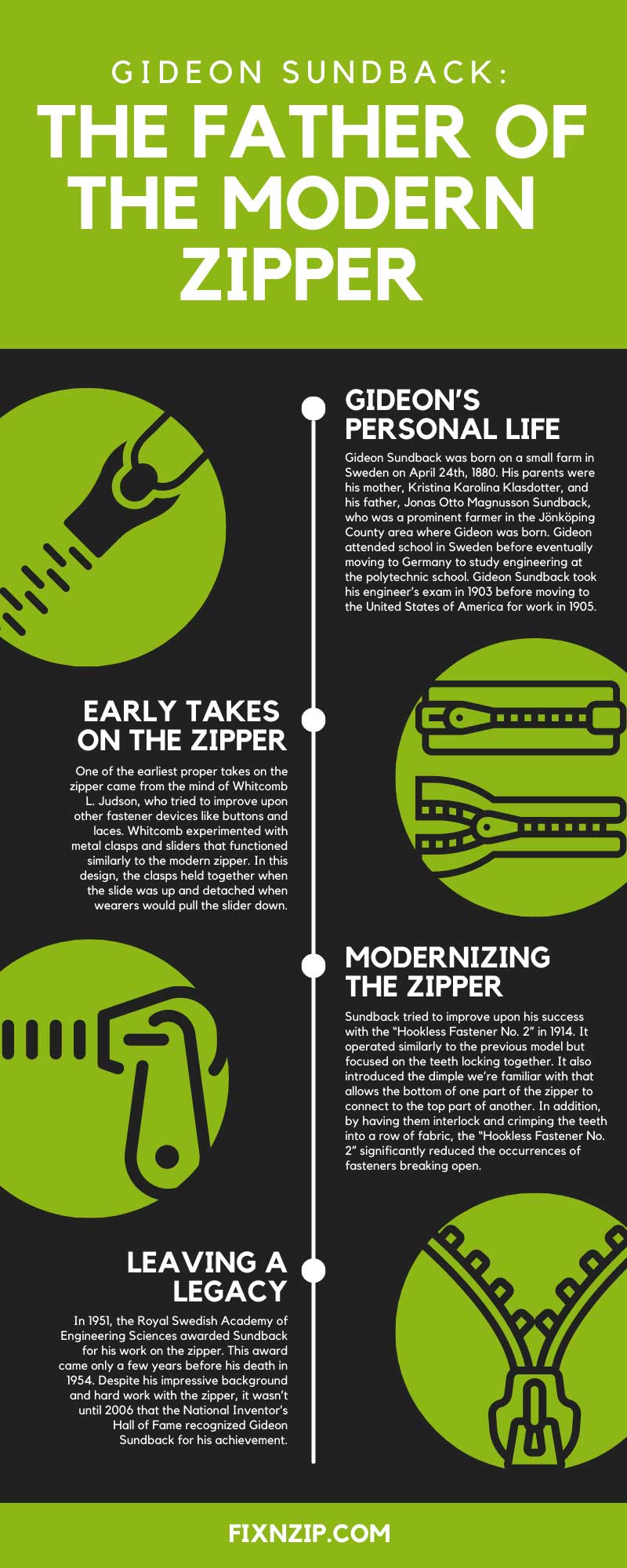
Gideon Sundback was born on a small farm in Sweden on April 24th, 1880. His parents were his mother, Kristina Karolina Klasdotter, and his father, Jonas Otto Magnusson Sundback, who was a prominent farmer in the Jönköping County area where Gideon was born. Gideon attended school in Sweden before eventually moving to Germany to study engineering at the polytechnic school. Gideon Sundback took his engineer’s exam in 1903 before moving to the United States of America for work in 1905.
Gideon lived in Pittsburgh, Pennsylvania, and got a job working at the Westinghouse Electric and Manufacturing Company. Westinghouse was once the biggest electrical infrastructure in the United States and employed other renowned names like Nikola Tesla and Bertha Lamme. However, Sundback only worked at Westinghouse for a year before moving to Hoboken, New Jersey, and gaining employment at the Universal Fastener Company in 1906. Sundback eventually married Elvira Aronson, the daughter of the plant manager, in 1909, a few years after he’d begun work on his new zipper design.
While we often refer to Gideon Sundback as the father of the modern zipper, the keyword to take from that is “modern.” It’s impossible to overstate Gideon’s work, but nearly everything he brought to the world came from early ideas, sketches, and designs from other engineers.
One of the earliest proper takes on the zipper came from the mind of Whitcomb L. Judson, who tried to improve upon other fastener devices like buttons and laces. Whitcomb experimented with metal clasps and sliders that functioned similarly to the modern zipper. In this design, the clasps held together when the slide was up and detached when wearers would pull the slider down.
One of the largest problems with the older Judson design, which had the working name of the “Judson C-curity Fastener,” was that the metal clasps rarely held together. Pressure from the inside of work boots or bags would cause the clasps to pop open, regardless of the slider’s position. Gideon Sundback wanted to try working with this design and improving upon it.
Earlier versions of Sundback’s attempts resulted in similar failures. The clasps would continuously burst open, and the metal fasteners proved less effective than other options. However, Sundback believed there was potential with this design and finally cracked the code in 1913.
The general idea was simple. If the metal fasteners kept bursting open, they needed to be held more tightly together. Ideas for Sundback’s “Hookless Fastener No. 1” increased the number of metal clasps alongside the fastener from four per inch to roughly 10. The two separate rows of teeth would pull together and lock more together from the slider, pulling them in a given direction. Sundback’s hookless fastener was the first iteration of the zipper that closely resembled the modern form.
Sundback tried to improve upon his success with the “Hookless Fastener No. 2” in 1914. It operated similarly to the previous model but focused on the teeth locking together. It also introduced the dimple we’re familiar with that allows the bottom of one part of the zipper to connect to the top part of another. In addition, by having them interlock and crimping the teeth into a row of fabric, the “Hookless Fastener No. 2” significantly reduced the occurrences of fasteners breaking open.
This design would eventually be the one that Sundback would sketch and use to apply for an official patent. Sunback submitted sketches to the patent office for his “Separable Fastener” on August 24th, 1914. The sketches showcased a Y-shaped slider and detailed drawings to showcase how the teeth could lock the fasteners in place. Patent clerks carefully analyzed the sketches and toyed with Sundback’s design until the separable fastener received official US patent 1,219,881 on March 20th, 1917.
Apart from creating the fastener and patenting it, Sundback put his engineering skills to work and created a machine to manufacture a long continuous chain of zipper teeth. This chain could be cut to any length and given a fastener. Shortly after beginning production, Sundback’s machine was making hundreds of feet worth of zipper per day.
While Sundback improved upon early designs and notes to patent, create, and manufacture what we now know as the zipper, the name itself came from a completely different source. US industrialist B.F. Goodrich pitched the name “zipper” after seeing how the fasteners worked on the boots that his plant was producing. The story goes that “zip” was a pleasant onomatopoeic sound effect from the slider moving up and down. This was a much catchier and snappier name than Sundback’s “separable fastener.”
In the early days, people mainly used zippers for boots and small pouches. Then, in the 1940s, they caught on in the fashion industry and became a widely accepted fastener option for dresses, slacks, jackets, and other garments.
In 1951, the Royal Swedish Academy of Engineering Sciences awarded Sundback for his work on the zipper. This award came only a few years before his death in 1954. Despite his impressive background and hard work with the zipper, it wasn’t until 2006 that the National Inventor’s Hall of Fame recognized Gideon Sundback for his achievement. To this day, Gideon’s quest to improve upon existing metal clasp designs with a focus on engineering and manufacturing enriches our lives and provides us with endless convenience.
If you’d like to learn more about zippers or read helpful guides on zipper repair, FixnZip is here for you. We have several useful blogs and are your one-stop shop for replacement zipper parts and sliders in several shapes and styles. Please browse through our catalog or contact us anytime with additional questions, comments, or concerns, and a member of our team will get you on the right track.
There’s an ongoing debate when it comes to jeans about whether button or zipper flies are better options for securing. While all zipper slides have a button at the top to help securely fasten them, some people prefer all-button flies. So, when you’re wondering what’s best for jeans, buttons or zippers, here are some things to consider.
Buttons have a much larger history with jeans that we don’t always consider. It wasn’t until the 1940s that jeans started incorporating zippers into the classic button fly. Many modern jeans bring back the buttons as a vintage throwback or a way to create a distinct aesthetic choice.
When considering whether buttons or zippers are best for jeans, you may also want to consider the jeans’ style. For tight, skinny jeans that serve a form-fitting function, zippers reign supreme. The smoother glide of the zipper is easier to hide and moves with the curve of the jeans and your body to create a more stylish look.
While both zippers and buttons have advantages, they each have some distinct disadvantages. Buttons, for example, require more motor skills and physical dexterity to fasten. Plus, if the jeans are too tight, sucking in and lifting up long enough to fasten multiple buttons can be a pain.
While zippers typically fasten more easily, they’re also more likely to break, stick, or come undone while wearing your jeans. No one ever wants to experience the embarrassment of hearing that their fly is down, which is a risk with zipper flies.
Zippers are an ideal choice for tight jeans, and many people prefer the convenience and ease of a zipper-button fly combo. The potential style options with button-fly jeans typically aren’t worth the additional discomfort and dexterous finger movements necessary to fasten them, especially on tighter garments.
If your jeans are ever in need of repair and you want the best source of zipper parts, FixnZip has you covered. Our shop has sliders, replacement kits, and helpful guides that make this your one-stop shop for all things zipper related. If you have any additional questions about our catalog, contact us anytime, and a member of our team will be happy to assist you.
Invisible zippers are popular with outdoor gear, raincoats, and dresses. The advantage is that the track, slider, and teeth are all inside the garment, so you can hardly see it from the outside when you close the zipper. Not only do invisible zippers provide a distinct look that many appreciate, but the positioning also protects the zipper from water damage and other potential hazards. Here are four quick tips for repairing an invisible zipper you may want to consider if you notice some problems.
If the main problem with your zipper is that you're having trouble sliding it, cleaning it may be an easy fix. Use a soft-bristled brush along the underside of the invisible zipper to clear out dirt or dust. You may also want to use a few drops of a zipper lubricant or other home remedies, like pencil graphite or olive oil, to loosen it up.
Installing a new slider is a quick tip for repairing an invisible zipper. Use pliers to remove the bottom stop and the current slider. After installing a new one, attach a new bottom stop and give the slider a few test zips to see that it’s properly working.
One advantage of invisible zippers is that they're typically metal. Sometimes, the biggest problem with a metal zipper is that the teeth bend or move. A quick fix may be to identify where the zipper is giving you problems and adjust the teeth back into the right shape. You can also position them with needle-nose pliers.
Replacing the tape is time-consuming, but you may need to do it if other methods aren't solving the problem. Use a seam ripper to carefully remove the zipper and any loose threads from your gear or garment. Hold the zipper in place with pins, and carefully run it through a sewing machine for the quickest and best results.
FixnZip can help you learn more about zipper replacements and maintenance. When you’re ready to buy a new zipper slide, the FixnZip® is the best slider for your needs. We have a wide selection of high-quality and affordable zipper slider replacements in different shapes and sizes for your next big project or repair job. Reach out to a member of our staff with any additional questions, comments, or concerns, and we'll be happy to get you on the right track.
In many situations, repairing a zipper may not require a total replacement. You can lubricate the zipper or use a pair of pliers to try and bend some of the metal teeth back into shape. Sometimes, you may need to replace the slider while leaving the track firmly attached to your garment or bag.
Replacing a zipper may seem daunting, but thankfully there are a few simple dos and don’ts for sewing in a zipper quickly and easily. Follow these tips, take it nice and slow, and you should be ready to handle just about anything the process can throw at you.
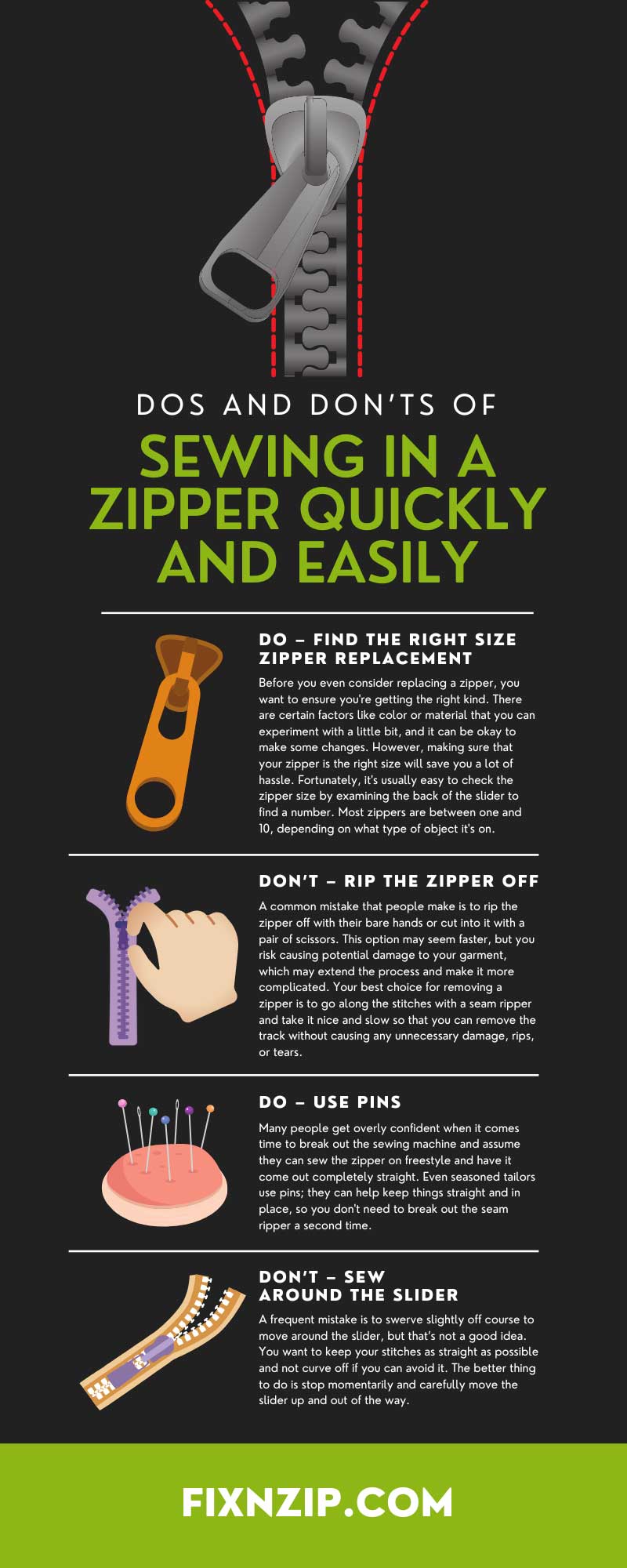
Before you even consider replacing a zipper, you want to ensure you're getting the right kind. There are certain factors like color or material that you can experiment with a little bit, and it can be okay to make some changes. However, making sure that your zipper is the right size will save you a lot of hassle. Fortunately, it's usually easy to check the zipper size by examining the back of the slider to find a number. Most zippers are between one and 10, depending on what type of object it's on. Many jackets have medium zippers between five and seven, while jeans, slacks, and skirts may have smaller zippers.
A common mistake that people make is to rip the zipper off with their bare hands or cut into it with a pair of scissors. This option may seem faster, but you risk causing potential damage to your garment, which may extend the process and make it more complicated. Your best choice for removing a zipper is to go along the stitches with a seam ripper and take it nice and slow so that you can remove the track without causing any unnecessary damage, rips, or tears.
Many people get overly confident when it comes time to break out the sewing machine and assume they can sew the zipper on freestyle and have it come out completely straight. Even seasoned tailors use pins; they can help keep things straight and in place, so you don't need to break out the seam ripper a second time. We recommend placing pins every three to four inches to attach the zipper to the first layer of fabric. Sometimes it may feel like you have too many pins, but the more you have, the more it will stay in place.
Whenever you’re sewing, it may feel a little more natural to have your fingers on the right side, especially if you’re right-handed. However, for control and safety reasons, it’s always good to get into the habit of keeping your fingers on the left side. When you keep your fingers firmly on the left side, you help keep your zipper straight and prevent it from sliding off to the left.
When you’re looking at the dos and don’ts of sewing in a zipper quickly and easily, that doesn’t mean that going fast is an essential part of the process. You’re far more likely to make a mistake if you try to rush it, so when you’re using the sewing machine, take it nice and slow. What makes the process quick and easy is that you don't have to fix your mistakes if you take your time and do it right by maintaining a slow and steady pace. You can save yourself a lot of hassle if you don’t push through it too quickly.
A common issue many people run into when replacing a zipper is getting to that bump where the slider is. A frequent mistake is to swerve slightly off course to move around the slider, but that’s not a good idea. You want to keep your stitches as straight as possible and not curve off if you can avoid it. The better thing to do is stop momentarily and carefully move the slider up and out of the way. Once you have it past your sewing needle, it shouldn't be a concern again, and you can finish the job without additional obstacles.
Once you have the zipper in place, you want to use firm pressure to hold it between the layers of fabric. Even with the pins in place to keep it from sliding off in another direction, it's always a good idea to push down with your fingers throughout the process. Maintain pressure by firmly pressing down while you slide your fabric through the sewing machine. The firm pressure allows you to keep the material sandwiched around the zipper on both sides and prevent any potential bubbles or minor bulges throughout the replacement process.
Some people argue whether or not you should remove the pins while sewing, and while you potentially can, there's no significant advantage to doing so. You can sew over the pins without causing any significant problems and take them all out simultaneously once you finish. The more you stop and remove your pins before sewing over them, the more time you spend and the greater the risk of you accidentally adjusting or sliding the zipper before you start moving again.
One option for those who want to avoid going over the pins while sewing but still want to avoid stopping and pulling them out is to slide the pins in a different direction to have them parallel with the end of your fabric. A helpful hint for this process is to make sure that the heads of the pins are facing you so that they're easy to remove.
If you need more assistance with zipper repair or need to browse through a trusted source of zipper parts, FixnZip is here for you. We have many helpful guides on repairing garments, luggage, and heavy-duty equipment. For more information or if you have any additional questions, comments, or concerns, please contact us anytime, and a member of our team will be happy to help.
No one wants to throw away their favorite jacket. You dig your hoodie out every year when it gets a little chilly, but at some point, the zipper may not work as well as it used to. Instead of tossing the whole thing out, consider one of these four simple tips for repairing a hoodie zipper. Hopefully, these tricks will get you more time with your warm coat.
If the zipper occasionally jams or has trouble sliding, you may just need to lubricate it a little bit. You can use a designated zipper lubricant, but a much more accessible option is to rub a graphite pencil around where the zipper pull is stuck. The graphite should help loosen it up and get the zipper back to proper working order.
If your hoodie has a metal zipper track, some of the teeth may be bent and you might need to make some adjustments. Fortunately, you can grab a pair of needle-nose pliers and carefully bend or crimp any errant metal to realign the teeth. It’s worth noting that this method doesn’t work very well if you have a plastic zipper.
One simple tip for repairing a hoodie zipper is to replace the slider if it’s too damaged. Zipper repair kits come with all the parts you need for replacement, and you can use your needle-nose pliers to remove the bottom stop and pull the slider off. Install the new slider and give it a few practice slides to make sure it’s moving smoothly before reattaching the bottom stop.
In a worst-case scenario, you may need to remove the entire zipper and replace it. You can use a seam ripper to carefully undo the stitches that keep your zipper in place. Then, use a needle and thread to attach a replacement and enjoy all the benefits of a clean, new zipper. This way, you won’t need to throw away your favorite hoodie.
To learn more about how to fix a zipper and how different methods work for different clothing, gear, or equipment, FixnZip is here for you. We have the best zipper replacement kits on the market, and helpful guides to lead you through any problem. For more information or to reach out to one of our specialists, please contact us anytime; we’ll be happy to get things on the right track for you.
Zippers allow you to quickly and securely close your suitcase. They have just one downside: it's common for them to get stuck or break. Nothing's more frustrating than fighting a zipper when you're in a rush to make it to the airport or your destination. Fortunately, we have the answers on what to do when your suitcase zipper breaks. Read below for quick, temporary repairs you can use on the fly and advice on replacing your zipper.
The good news is that you can usually repair your malfunctioning zipper. Use zipper pliers to straighten misaligned or crooked teeth if your zipper separates. Then, realign the plates. If your zipper is stuck, check for loose thread in the teeth. You can use tweezers to remove it. Alternatively, you can use a graphite pencil or wax to lubricate the teeth and help the zipper glide along the track.
Keep in mind that repair is often a temporary solution. Using pliers or other forceful methods to fix your zipper can result in further wear and tear that leads to repeated breakage down the line.
In some situations, quick fixes won't do the trick. What should you do when your suitcase zipper is badly broken? You'll likely need to purchase and install a replacement zipper if the teeth separate, the slider comes off, or the zipper falls off the track.
Luckily, replacement zippers—and the tools you need to attach them—are readily available and relatively cheap. Scouring the internet or your local craft store for each part and tool can eat up a lot of time, as can meticulously sewing and plying your new zipper into place. Is there an easier solution?
FixnZip's zipper repair kits allow you to handle any zipper repair emergency gracefully. You can use our innovative zipper pull replacement to fix broken zippers without tools or sewing. The FixnZip® works on nylon coils, plastic teeth, and metal teeth and fits a wide range of zipper sizes so you can effortlessly repair your suitcase on the go. Purchase your kit today or contact us to learn more about how our product works.